

Introduction
Singapore’s dense urban environment, heavy reliance on electronics, and busy commercial kitchens make quick, effective fire response essential. A well-chosen and well-maintained fire extinguisher can stop a small outbreak before it becomes a building-wide emergency. In 2026, as workplaces and homes embrace smart monitoring and greener disposal practices, understanding dry powder fire extinguisher selection, use and servicing remains a core safety requirement for households and businesses across the island.
This guide explains how dry powder extinguishers work, where they are best used, SCDF-aware servicing and disposal practices, and practical tips to help you keep people and property safe.
What is a dry powder fire extinguisher and how does it work?
A dry powder fire extinguisher contains a granular extinguishing agent—often an ABC multipurpose powder—stored under pressure. It works primarily by coating the burning material and interrupting the chemical reaction of the fire, while also providing some smothering action to cut oxygen supply.
Key advantages:
- Multipurpose performance: effective on Class A (solids), Class B (flammable liquids) and Class C (flammable gases/electrical) fires.
- Fast knockdown: powder can quickly suppress flames in many common scenarios.
- Cost-effective: generally cheaper per unit than some specialist agents.
Limitations to know:
- Residue: powder leaves a corrosive or abrasive residue that can damage electronics, mechanical equipment and sensitive interiors; cleanup is often intensive.
- Visibility and inhalation concerns: discharge creates dust clouds—avoid breathing powder and ventilate after use.
- Not ideal for kitchens where deep-frying oil fires (class F) may require wet chemical extinguishers.
When choosing a dry powder fire extinguisher, match the class rating and size to the risk profile of the area to be protected.
Why dry powder extinguishers are common in Singapore
The versatility of dry powder agents makes them popular for general-purpose protection across Singapore’s mixed-use buildings, industrial sites and many commercial premises. Their ability to tackle several classes of fire with one device is attractive to property managers, logistics hubs and construction sites where multiple fuel types are present.
However, Singapore’s emphasis on protecting critical infrastructure and sensitive electronics means dry powder isn’t always the default choice. In server rooms, hospitals or high-value retail, CO2 or clean agent extinguishers are often preferred to reduce equipment damage. For kitchen environments, wet chemical extinguishers remain the recommended option.
Choosing the right fire extinguisher for your home or business
Selecting the correct extinguisher depends on the fire risks in the area. Consider common hazards: cooking oils, electrical equipment, flammable liquids, storage of combustibles, and whether the area contains sensitive electronics.
Practical selection tips:
- For general household use, a 1kg–2kg dry powder or 2kg–3kg CO2 unit may be suitable; larger premises should have appropriately rated and multiple portable units.
- Kitchens: choose a wet chemical extinguisher rated for cooking oil (Class F) in addition to a general-purpose extinguisher located outside the kitchen area.
- Workshops, garages and construction sites often benefit from larger dry powder units because of mixed fuel types.
- Sensitive equipment rooms should use non-residue agents where possible.
For SCDF-aligned guidance on appropriate extinguisher types and placement in Singapore, review local resources like the official SCDF extinguisher guide and recommendations to ensure compliance and best practice: https://nationalcitycorporation.sg/scdf-fire-extinguisher-guide-singapore-fire-safety-company-2/.
Placement, mounting and accessibility
- Mount extinguishers so they’re visible and reachable—typically 1–1.5 metres above floor level for the carrying handle.
- Keep unobstructed clearance around the unit and signpost their locations with standard pictogram signs.
- Place extinguishers at exits, near high-risk areas, and within the same storey as the hazard.
- For multi-storey buildings, ensure extinguishers are available on every level and that staff know their locations.
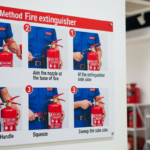
How to use a dry powder fire extinguisher safely (PASS)
Follow the PASS mnemonic for portable extinguisher operation:
- Pull: Pull the safety pin or tamper seal.
- Aim: Aim the nozzle at the base of the fire, not the flames.
- Squeeze: Squeeze the lever to discharge the powder.
- Sweep: Sweep the nozzle side-to-side across the base of the fire until extinguished.
Safety notes:
- Keep an escape route behind you and never let the fire block your exit.
- If the fire is spreading rapidly, evacuate and call the fire brigade.
- Avoid discharging powder into confined spaces where inhalation risk is high—ventilate immediately after use.
Servicing, inspection and certification in Singapore
Regular inspection and professional servicing are critical to ensuring your extinguisher will perform when needed. Visible pressure loss, damaged hoses or corroded bodies are non-negotiable triggers for servicing or replacement.
Recommended maintenance practices:
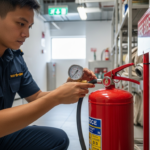
- Monthly quick checks by on-site staff: seal intact, pressure gauge in green, no obvious damage.
- Annual professional servicing by a licensed company: full inspection, weight check, internal examination where applicable and re-tagging.
- Follow the manufacturer’s and SCDF’s recommendations for longer-term testing (for example, hydrostatic testing or internal maintenance) and replacement intervals.
For trusted local servicing, certification and detailed SCDF-aligned maintenance procedures, consult professional providers listed by Singapore fire safety experts: https://nationalcitycorporation.sg/fire-extinguisher-servicing-and-safe-disposal-singapore-2026/.
Replacement and responsible disposal
When an extinguisher fails inspection, leaks, is heavily corroded, or is past the recommended lifespan, it should be replaced. Dry powder units that have been discharged typically cannot be refilled cheaply and are often replaced with a serviced unit.
Disposal considerations in Singapore:
- Do not throw discharged or expired extinguishers into general waste or recycling bins. The residual agent and pressurised vessel require controlled handling.
- Use licensed disposal or recycling services that follow environmental and safety rules.
- Some extinguisher suppliers offer replacement-and-takeback programs—ask about collection and safe disposal.
Official SCDF and industry resources provide step-by-step disposal guidance and tips for 2026 operations: https://nationalcitycorporation.sg/scdf-fire-safety-tips-for-fire-extinguisher-disposal-2026/ and https://nationalcitycorporation.sg/fire-extinguisher-replacement-and-disposal-singapore-2026/.
Choosing a service provider in Singapore
Select a vendor who is licensed, has good local references and offers clear reporting and tagging after routine servicing. Verify their scope includes: on-site checks, pressure and weight verification, component replacement, recharging (if applicable), and responsible disposal of spent units.
For a vetted list of companies experienced with portable extinguishers and SCDF compliance, consider local specialist directories and firms that focus on Singapore fire safety: https://nationalcitycorporation.sg/top-singapore-fire-safety-co-for-portable-extinguishers-2026/.
New trends and considerations for 2026
- Smart monitoring: more facilities are adopting IoT-enabled extinguisher sensors to track tamper status, pressure and location—useful for large campuses and high-traffic sites.
- Green disposal and recycling: 2026 sees better takeback programs and specialist recyclers trained to handle pressurised cylinders and powders safely.
- Hybrid protection strategies: businesses increasingly use a combination of agent types—dry powder for general-purpose, CO2 or clean agents for electronics, and wet chemical for kitchens.
- Workplace training: more organisations are formalising hands-on extinguisher training and scenario drills to improve first-response confidence among staff.
Practical checklist for owners and managers
- Identify: Map high-risk areas and assign the appropriate extinguisher type for each zone.
- Inspect: Perform quick monthly checks; document results.
- Service: Engage a licensed servicing company annually, and follow manufacturer guidance for additional tests.
- Replace: Replace extinguishers that fail inspections or are past recommended service life.
- Dispose responsibly: Use licensed collection and disposal partners—don’t discard into municipal waste.
- Train: Provide basic PASS training and evacuation drills for occupants and staff.
Conclusion
A dry powder fire extinguisher is a versatile, cost-effective tool for many fire risks across Singapore, but it’s not a universal solution. Understand the strengths and limitations of powder, choose the right extinguisher for the hazard, and commit to regular inspections, professional servicing and responsible disposal. Staying aligned with SCDF guidance, adopting modern monitoring where appropriate and working with licensed service providers will keep your people and premises safer in 2026 and beyond.
For more practical guidance, service providers and SCDF-compatible resources, refer to the local guides and expert pages linked throughout this article to ensure compliance and best practice.

No comment yet, add your voice below!