

Introduction
Singapore’s dense urban environment and humid coastal climate make fire safety a top priority for building owners, facility managers and occupiers. Proper fire alarm maintenance and timely servicing of dry powder fire extinguishers are essential to protect lives, limit property damage and meet regulatory expectations. This guide brings practical maintenance and inspection tips for 2025 — including current trends such as IoT monitoring, digital logs and best practices tailored to Singapore.
Why fire alarm maintenance matters in Singapore
A well-maintained fire alarm system is the building’s first line of defence. Regular maintenance ensures detectors respond to smoke and heat reliably, control panels log events accurately, and notification appliances (sirens, strobes) alert occupants effectively. Factors specific to Singapore — high humidity, salt-air corrosion in coastal areas, and heavy foot traffic in commercial buildings — can accelerate wear and reduce system reliability if not routinely checked.
Beyond safety, consistent fire alarm maintenance supports compliance with local fire safety rules and insurance requirements. Accurate records and prompt rectification of faults also reduce the risk of false alarms, which can be costly and disruptive.
Practical fire alarm maintenance checklist
Routine checks should combine in-house visual inspections with scheduled professional servicing. Use this practical checklist as a baseline and align intervals with manufacturer guidance and your certified maintenance contractor.
- Monthly (basic in-house checks)
- Inspect the fire alarm control panel (FACP) for fault indicators and power supply status.
- Check batteries for corrosion and confirm charger/backup status.
- Verify that manual call points (break-glass) are unobstructed and accessible.
- Walk the building to ensure no detectors are covered, painted over, or physically damaged.
-
Log any observations in a digital or paper maintenance register.
-
Quarterly (semi-technical checks)
- Test a sample of smoke detectors, heat detectors and manual call points for correct signaling to the FACP.
- Confirm sounder and strobe functionality in different zones.
-
Clean detectors gently if dust or debris is visible (follow manufacturer cleaning instructions).
-
Annual (comprehensive professional service)
- Full system functional test by a licensed fire alarm servicing company.
- Detector sensitivity testing and recalibration where needed.
- Battery capacity testing and replacement if performance is below threshold.
- Firmware and software updates for addressable panels and networked components.
- Issuance of a service report and updated compliance documentation.
2025 trends in fire alarm maintenance
Maintenance is evolving rapidly. For 2025, expect to see these trends in Singapore:
- IoT and remote monitoring: Fire alarm panels and detectors connected to the cloud enable 24/7 status tracking, anomaly alerts and remote troubleshooting.
- Predictive maintenance: Analytics on event logs and detector trends can predict failures before they happen, reducing unplanned downtime.
- Wireless detectors and easier retrofits: Less invasive installation for older buildings, reducing renovation costs.
- Digital inspection workflows: NFC tags on devices and mobile apps simplify monthly checks and create tamper-proof maintenance histories.
- Integration with building management systems (BMS): Faster response and coordinated building controls (e.g., access control and HVAC) during incidents.
These technologies improve reliability and make maintaining compliance less labor-intensive — but they require authenticated installers and robust cybersecurity practices.
Dry powder fire extinguisher: why it’s common and where to use it
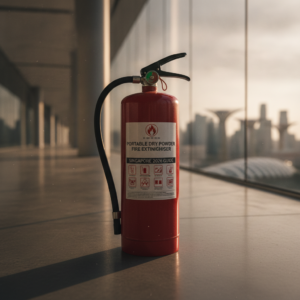
The dry powder fire extinguisher is widely used across Singapore because of its versatility. Dry powder (often labelled ABC powder) is effective on Class A (combustibles), Class B (flammable liquids) and Class C (flammable gases or electrical) fires. This makes it ideal for workshops, plant rooms, kitchens with certain risks, vehicle parks and general-purpose coverage.
However, dry powder is not always the right agent for enclosed spaces where cleanup is difficult. It can obscure visibility and contaminate sensitive equipment, so placement decisions should be risk-based and documented.
Dry powder fire extinguisher refill and inspection: step-by-step
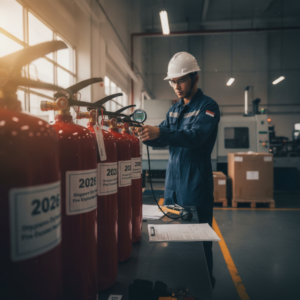
Refilling and servicing dry powder extinguishers must be performed by trained and licensed technicians. Here’s what to expect during a professional refill and inspection service:
- Pre-service inspection
- Verify the unit identity, last service date and any discharge history recorded on the tag.
- Check for dents, corrosion, nozzle/hose integrity and operability of the lever/handles.
-
Confirm the tamper seal and pin are present (if the unit has been used, the seal will be broken).
-
Weigh and gauge check
- Weigh the extinguisher to confirm remaining agent level if marked as rechargeable.
-
Check the pressure gauge (if fitted) and compare to manufacturer acceptable range.
-
Discharge and refill (if required)
- If the unit shows reduced agent or has been partially discharged, the technician will fully discharge, clean and refill to the specified charge weight using the correct powder formulation.
-
Replace any damaged hoses, nozzles, O-rings, valves or seals.
-
Re-pressurisation and testing
- Recharge to the proper pressure and perform a functional test to ensure the valve and nozzle operate correctly.
-
For cylinders requiring hydrostatic testing, the technician will advise the schedule and either perform the testing or send the cylinder to an accredited test house.
-
Labelling, tagging and logging
- Attach a service tag with date, technician name, next service date and any observations.
- Update the building’s digital maintenance log and provide the client with a service report.
Inspection intervals and regulatory notes
General inspection guidance used across buildings in Singapore typically includes:
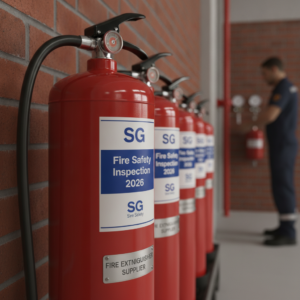
- Monthly visual checks by the occupier or appointed staff (quick walk-around check).
- Annual professional inspection and servicing by a licensed fire protection company.
- Hydrostatic testing and major overhauls according to manufacturer, cylinder type and regulatory standards.
Hydrostatic test intervals vary by cylinder construction and design; always follow the extinguisher label, manufacturer data and local authority guidance. Maintaining clear, dated records helps demonstrate compliance during audits.
Coastal and humidity considerations in Singapore
Buildings near the coast or in high-humidity zones require extra vigilance:
- Increased corrosion risk: Metal components and valves can corrode faster — more frequent visual checks and protective coatings may be needed.
- Detector sensitivity drift: High humidity and condensation can affect smoke detector performance; regular sensitivity checks are important.
- Storage and exposure: Avoid storing spare extinguishers in direct sunlight, open weather or areas where salt spray may accumulate.
Choosing a licensed service provider in Singapore
When selecting a vendor, consider:
- Certification and licensing: Confirm the company and technicians are licensed and experienced with local codes.
- Clear scope of service: Ask for detailed inspection reports, digital records and transparent pricing.
- Capacity for both fire alarm maintenance and extinguisher servicing: Integrated providers simplify coordination and recordkeeping.
- Technology adoption: Providers using digital logs, NFC tagging or remote monitoring can speed up compliance reporting.
- Emergency response times and warranty terms.
Quick checklist for busy building managers
- Maintain a visible, up-to-date fire safety log (digital preferred).
- Conduct monthly visual checks of all extinguishers and the fire alarm control panel.
- Schedule annual professional inspections and keep service reports on file.
- Ensure any discharge is recorded and the extinguisher is replaced or refilled immediately.
- Verify detectors are cleaned and sensitivity-tested annually, or more frequently in dusty/humid environments.
- Use licensed contractors and ask for proof of training and certifications.
- Consider IoT-enabled monitoring for large estates and high-value assets.
Conclusion
Effective fire protection in Singapore combines disciplined routines, professional servicing and modern monitoring tools. Regular fire alarm maintenance paired with proper dry powder fire extinguisher refill and inspection routines reduces risk, helps meet regulatory expectations and improves readiness during an emergency. Building owners and facility managers who document inspections, engage licensed service providers and adopt practical tech upgrades will be better positioned to protect people and assets in 2025 and beyond.
Schedule routine checks, keep accurate records and prioritise licensed, experienced technicians for critical tasks such as refills, recharging and hydrostatic testing to ensure systems work when they are needed most.


No comment yet, add your voice below!