

Why responsible fire extinguisher disposal matters in Singapore
Expired, damaged or discharged fire extinguishers are not ordinary waste. They contain pressurised cylinders, extinguishing agents and sometimes ozone-depleting compounds (older halon units) — all of which require specialist handling. Using an SCDF approved singapore fire safety company ensures legal compliance, protects building occupants and the environment, and avoids fines or unsafe DIY attempts. In 2025 the emphasis is stronger than ever on traceable, green disposal and rapid service turnaround.
When you need professional fire extinguisher disposal
Common scenarios requiring disposal or recycling:
– Extinguishers past their hydrostatic test date or service expiry.
– Damaged, corroded or leaking cylinders.
– Discharged units that cannot be refilled.
– Old halon extinguishers or recalled models that need specialist reclamation.
– Building renovation, demolition or equipment replacement where extinguishers are surplus.
If an extinguisher is still within serviceable life and not damaged, servicing or refilling by a licensed technician may be the right call. For expired, damaged or specialist agents, seek an SCDF-approved singapore fire safety company for safe disposal and environmentally responsible recycling.
What an SCDF approved singapore fire safety company does for disposal and recycling
Reputable, approved companies follow a standard process that meets SCDF and environmental guidelines:
– Inspection & classification: confirm agent type (dry powder, foam, CO2, water, halon, etc.), cylinder condition and service history.
– Safe depressurisation: discharge or recover pressurized gas in a controlled environment.
– Agent recovery or neutralisation: recover reusable agents where possible (e.g., CO2 reclamation) or neutralise/dispose of residues safely.
– Cylinder processing: puncture, shred or cut cylinders and segregate metal parts for recycling.
– Hazardous component handling: arrange for specialist treatment of halon or other controlled substances.
– Documentation: provide proof-of-disposal, chain-of-custody records and certificates required by regulators or building management.
In 2025 many firms also provide digital records and QR-linked certificates showing the disposal history for compliance audits.
Step-by-step guide to booking fast fire extinguisher disposal in 2025
- Prepare basic information: number of units, extinguisher types (e.g., 1kg dry powder, 5kg CO2), last service dates, photos and the site address.
- Verify SCDF approval: ask for the company’s SCDF licence or approval reference and cross-check with their UEN and company registration details.
- Request quotes and turnaround times: specify whether you need same-day or next-day collection and ask about bulk discounts.
- Confirm scope: ensure the quote covers collection, depressurisation, agent recovery, recycling, transport and the disposal certificate.
- Book online or by phone: many 2025 providers have booking portals with real-time slot availability, mobile payments and e-signatures.
- Prepare the site: allocate a parking bay, ensure safe access to the extinguishers, and designate a staff contact for the technician.
- Receive certificate and digital records: after service you should receive a disposal certificate and an electronic chain-of-custody record.
What to check before you hire a company
When comparing providers, ask these practical questions:
– Are you SCDF-approved/licensed and can you show proof? Always verify their credentials.
– Do you carry public liability and professional indemnity insurance for on-site work?
– How do you handle halon or other controlled agents?
– What is the expected turnaround (same-day, 24–72 hours, or longer)?
– Is collection included or charged separately? Are there minimum fees?
– Will I receive a physical and digital disposal certificate and chain-of-custody?
– What percentage of materials are recycled, and where are they sent?
A trustworthy singapore fire safety company will answer transparently and provide references from local clients.
Typical costs and timelines (what to expect in 2025)
Costs vary by extinguisher type, size and agent, plus logistics and local regulation. Typical guidelines:
– Small domestic units (1–2 kg dry powder or water): usually lower-cost to process.
– CO2, larger foam or 9 kg units: higher handling costs due to weight and special processing.
– Halon or specialist agents: premium charges because of regulated reclamation.
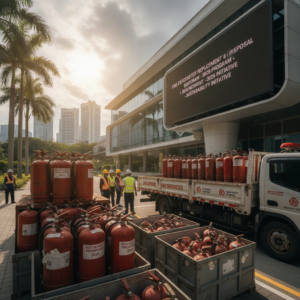
– Collection: many companies include collection for nearby addresses; remote locations may incur a travel fee.
Turnaround: many approved companies now offer same-day or next-day pickups for urgent needs. For scheduled bulk disposals, allow 3–10 working days to coordinate collection and certificates.
Always obtain at least two quotes, request a clear scope of work and confirm included documentation.
What happens on the service day
A typical on-site flow:
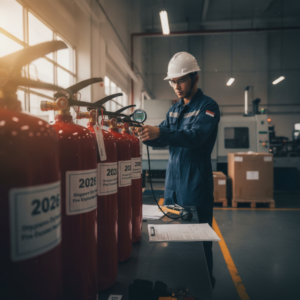
– Technician arrives with protective gear, tools and transport manifest.
– Units are inspected and verified against the booking list.
– Pressurised contents are safely dealt with: recovered for reclamation or safely discharged to a capture system.
– Cylinders are rendered safe (punctured or cut) and segregated for metal recycling.
– Technician provides a completion report and issues a disposal certificate (often both paper and digital).
For high-rise or constrained sites, ask about manpower or equipment needed to move units safely.
Documentation you should receive
Insist on receiving:
– A signed disposal certificate showing date, quantity, agent types and the technician’s licence/ID.
– Chain-of-custody documentation or manifest for transport and recycling facilities.
– Digital records or QR codes linked to the disposal file (increasingly common in 2025).
These documents are useful for audits, building management records and demonstrating regulatory compliance.
2025 trends: sustainability, traceability and faster booking
The marketplace is evolving:
– Digital-first bookings: apps and portals allow instant quotes, slot selection and electronic payment.
– Traceable recycling: QR-coded cylinders and digital certificates create a verifiable disposal trail for regulators and corporate sustainability reporting.
– Green reclamation: more firms reclaim CO2 and metal for recycling, and specialist partners manage halon reclamation or safe destruction.
– Same-day emergency services: larger singapore fire safety company networks offer rapid collection for urgent decommissioning or incident-related disposals.
These trends make it easier for facility managers and homeowners to get fast, compliant disposal while supporting circular economy goals.
Quick checklist before you hit “book”
- Confirm SCDF approval and check the company UEN.
- Prepare extinguisher details and site access information.
- Ask for a full scope and disposal certificate.
- Compare at least two quotes including collection and documentation.
- Check insurance, halon handling capability and recycling destinations.
Using an SCDF approved singapore fire safety company protects you legally and ensures extinguishers are handled safely and sustainably. With digital tools and improved traceability in 2025, you can secure fast bookings, clear documentation and higher recycling outcomes, reducing risk and supporting Singapore’s sustainability goals.


No comment yet, add your voice below!