

Why replacing and maintaining fire extinguishers matters in 2025
Fire extinguishers are low-cost life-safety devices with outsized legal and operational impact. For businesses and property managers in Singapore, keeping extinguishers fit-for-service is both a regulatory obligation and a practical way to lower risk, insurance claims and downtime. Advances in digital inspections, IoT-enabled monitoring and QR-tagged servicing are changing how facilities managers meet SCDF expectations — delivering faster audits, better record-keeping and predictive maintenance.
This guide explains what to inspect, when to replace, how technology is used today, and how to stay compliant with Singapore’s fire-safety landscape.
SCDF compliance: the framework and practical implications
The Singapore Civil Defence Force (SCDF) enforces fire safety standards and the Fire Safety Act. While operational details change and some technical requirements vary by building type, the practical implications for owners and managers are consistent:
- Portable firefighting equipment must be installed, maintained and certified by competent persons.
- Records of inspections, servicing and replacements must be kept for audits.
- After any use or discharge, extinguishers must be recharged or replaced and documented.
Actionable step: Engage SCDF-licensed or industry-accredited contractors for annual servicing and keep digital records for at least the period required by your building type or insurer.
Routine maintenance schedule (recommended best practice)
A standard maintenance rhythm keeps extinguishers reliable and simplifies SCDF audits:
- Daily/Weekly: Basic visual checks where practical (is the extinguisher in place? Visible damage? Pressure gauge in the green?). Many workplaces do this weekly.
- Monthly: Formal visual inspection by an on-site staff member or facilities lead; check tamper seals, accessibility, signage and obvious corrosion.
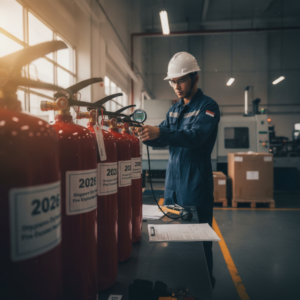
- Annual: Full service by a licensed technician. This includes internal/external inspection, recharging (if required), replacement of seals and parts, and updating certification tags/logs.
- After discharge: Immediate recharge or replacement regardless of the next scheduled service.
- Major testing/hydrostatic testing: Type-dependent and usually carried out by specialists at manufacturer-recommended intervals (commonly every 5–12 years for many extinguisher types).
Note: Exact intervals can vary by extinguisher type (CO2, water, foam, dry chemical) and manufacturer — always follow the manufacturer’s guidance and confirm with your servicing contractor.
When to replace a fire extinguisher
A replacement is warranted, not just a recharge, in several cases:
- Failed hydrostatic test or irreparable internal damage.
- Severe corrosion, dents or structural deformation that may compromise containment.
- Repeated or partial discharges that have degraded the extinguishing agent or cylinder integrity.
- Missing or illegible manufacturing/inspection markings that prevent reliable history tracking.
- Extinguisher is beyond recommended service life per manufacturer guidance.
Practical signposts: Replace immediately if the gauge is persistently out of range, the cylinder shows rust through the paint, or the nozzle and valve assembly are damaged.
How IoT inspections are changing maintenance
IoT-enabled extinguishers and sensor kits are growing in adoption across Singapore commercial properties. Typical capabilities include:
- Pressure and tamper sensors that report status to a cloud dashboard.
- Real-time alerts for low pressure, discharge or removal from a bracket.
- Integration with building management systems (BMS) and centralized maintenance platforms.
- Reduced manual checks and faster response times for missing or faulty units.
Benefits: Less administrative overhead, better continuity of records for SCDF audits, and predictive insights (e.g., units trending toward low pressure can be serviced before failure).
Caveat: IoT reduces inspection burden but does not replace certified annual servicing. Sensors support but do not substitute licensed technician checks and statutory tests.
QR-tagged servicing: the paperless audit trail
QR tags attached to each extinguisher are now standard practice for many forward-looking service providers. Scanning the QR code provides instant access to:
- Last service date and technician details.
- Next scheduled maintenance, hydrostatic test dates and replacement history.
- Digital certificates, photos and service notes.
This simplifies audits: instead of hunting for paper tags, auditors and facilities teams scan to verify service history. For multi-site operators, QR-tagging dramatically reduces the time to demonstrate compliance across portfolios.
Selecting a service provider in Singapore: what to look for
When choosing a maintenance and replacement vendor, evaluate them on more than price:
- Accreditation and licensing: Confirm the vendor uses SCDF-recognized practices or is accredited by relevant local bodies.
- Digital capability: Do they provide QR tags, cloud-based logs and IoT options? These features save time and provide audit-ready records.
- Response time: Check SLAs for emergency recharges, replacements and after-discharge service.
- Transparency: Clear quotations for replacement units, mounting, disposal and certification.
- Warranty and parts availability: Ensure replacement extinguishers and parts meet local standards and are backed by warranty.
Ask for sample reports and digital access to past records when evaluating bids.
Documentation and record-keeping: what to retain
For each extinguisher, maintain a digital file containing:
- Make, model, capacity and serial number.
- Installation date and exact location within the building.
- Service history: inspection dates, technician name, work performed and signatures or digital confirmations.
- Hydrostatic test certificates and replacement invoices.
- After-use reports and disposal documentation.
Retain records according to SCDF guidance and insurer requirements. Digital storage with QR linkage reduces the risk of lost paperwork.
Budgeting and cost considerations (practical ranges)
Costs vary with extinguisher type and size, but you can budget using these indicative ranges (SGD):
- Small portable dry chemical extinguisher replacement: ~S$70–S$160.
- Medium/large units, CO2 or specialist agents: ~S$150–S$800+ depending on agent and capacity.
- Annual maintenance/service (per unit): ~S$20–S$80 depending on contract scale and service scope.
- IoT sensor add-on / QR-tagging and setup: initial per-unit setup S$30–S$120 plus subscription for dashboards.
These are indicative. Ask for a full quote including disposal of replaced units, labelling and certification. Factor in the long-term savings from IoT (fewer manual checks, faster fault detection) when comparing capital and operational costs.
Implementation checklist for managers (quick action plan)
- Conduct a full inventory of extinguishers, noting type, serial numbers and locations.
- Verify current service status and attach QR tags if not present.
- Schedule annual servicing with a licensed contractor and get digital proofs.
- Prioritise replacements for units with corrosion, failed tests, or missing records.
- Pilot IoT-enabled monitoring in high-risk areas (kitchens, plantrooms) to learn benefits before a full rollout.
- Keep a central digital repository for all certificates and invoices for audit readiness.
Closing summary
In 2025 Singapore, fire extinguisher replacement and maintenance is a blend of established safety practice and modern digital tools. Compliance with SCDF guidance, timely servicing by licensed technicians, and thoughtful adoption of IoT and QR-tagged servicing create a resilient fire-safety program that reduces risk and simplifies audits. By treating extinguishers as managed assets — tracked, tested and replaced when needed — businesses protect people, property and continuity with minimal friction.
Adopt a proactive maintenance cadence, choose reputable service partners with digital capabilities, and use QR/IoT tools to make compliance verifiable and efficient. The result is better safety outcomes and a clear record trail for both regulators and insurers.




No comment yet, add your voice below!