

Why fire extinguisher knowledge matters in Singapore
Fire safety in Singapore is a statutory priority.
Types of fire extinguisher agents and what to use where
Knowing which extinguisher suits which hazard is the first step to effective protection:
- Water (APW): suitable for Class A fires (wood, paper, textiles). Not for electrical or grease fires.
- Foam (AFFF): good for Class A and some Class B (flammable liquids); not for deep-fat frying hazards.
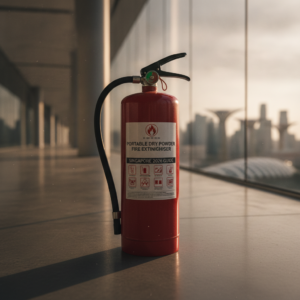
- Dry powder (ABC / BC): versatile and commonly used in commercial settings. See a TUV SUD PSB approved dry powder model here: TUV SUD PSB approved dry powder fire extinguisher.
- CO2: suitable for electrical fires and some Class B fires; leaves no residue but has limited cooling effect.
- Wet chemical: specifically for Class F (kitchen deep-fat frying) fires — essential for F&B kitchens.
Always match extinguisher type and capacity to the risk. A kitchen, office, retail shop and industrial unit will each require a different mix of extinguishers and capacities.
Placement, sizing and fire safety standards
Key practical rules:
- Mounting height and signage: extinguishers should be mounted at accessible heights and clearly signposted with durable signage and floor plans.
- Capacity: match extinguisher capacity (kg or litres) to the area protected — larger spaces often require multiple units rather than one oversized extinguisher.
Inspection, maintenance and record-keeping: staying compliant
Regular inspection and maintenance are statutory obligations. A typical compliance schedule includes:
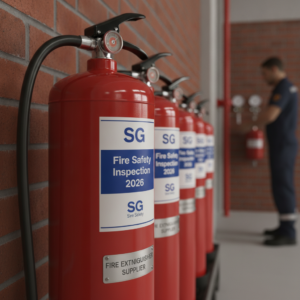
- Monthly visual checks: ensure pressure gauge in range, tamper seals intact, no obvious damage or corrosion.
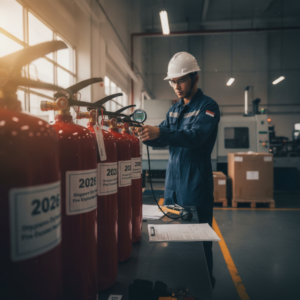
- Annual service: performed by certified technicians to inspect, recharge, replace parts or conduct hydrostatic testing where required.
- Extended testing: periodic pressure testing or internal examination as required by the type and age of the extinguisher.
- Records: maintain detailed service logs and inspection tags. Digital logs and QR-coded records are becoming standard for quick audits.
If you manage multiple sites or outsource fire safety, use a robust checklist so nothing is missed — an example supplier checklist for fire extinguisher compliance is available here: fire extinguisher checklist for suppliers.
Choosing the right Singapore fire safety company
Selecting a competent Singapore fire safety company affects long-term compliance and the operational reliability of your extinguishers. Key selection criteria:
- Service coverage and response times: for commercial properties, fast turnaround and emergency response are critical.
- Comprehensive service plans: look for companies offering scheduled maintenance, emergency refill/repair, and digital record-keeping.
- References and track record: ask for case studies in similar industries (F&B, retail, industrial) and client references.
- Transparent pricing and warranty: ensure service contracts detail inspection frequency, parts replacement and escalation processes.
Training staff to use fire extinguishers safely
Even the best equipment is ineffective without trained personnel. Practical training reduces panic and ensures safe, controlled action before emergency services arrive. Key training elements:
- PASS technique: Pull the pin, Aim low at the base, Squeeze the handle, Sweep side to side.
- Recognising fire classes: ensure staff know which extinguisher to use for which fire (never use water on grease or electrical fires).
- When not to fight a fire: training must emphasise evacuation, alarm raising and life-safety over property preservation.
- Practical drills: hands-on practice with training units and simulated scenarios builds muscle memory.
Many Singapore fire safety companies provide on-site practical training and refresher courses as part of their service packages.
Modern trends: digitalisation and integrated systems in Singapore fire safety
Singapore’s fire safety landscape is evolving with technology. Adopting modern tools can streamline compliance and improve response:
- QR-coded inspection tags and mobile apps: technicians scan equipment to update service records instantly; auditors can access history in seconds.
- IoT-enabled monitoring: smart sensors can detect pressure loss, tampering or temperature anomalies and send alerts.
- Integrated fire protection systems: combining extinguishers with alarms, sprinklers and building management systems provides a coordinated response.
- Green extinguishing agents: manufacturers are developing environmentally friendlier agents and low-global-warming-potential options for certain applications.
Practical checklist for business owners and facility managers
- Identify hazards and map extinguisher types to each area (kitchen, electrical rooms, storage).
- Verify each extinguisher is TUV SUD PSB approved and correctly sized.
- Confirm mounting height, signage and unobstructed access.
- Implement monthly visual checks and schedule annual servicing with a certified Singapore fire safety company.
- Train staff annually in extinguisher use and evacuation procedures; conduct at least one drill per year.
- Review supplier contracts for clear response SLAs and replacement warranty.
- Consider technology: QR tags or a maintenance portal to centralise records and speed up audits.
For a ready-made supplier checklist you can share with procurement, see: fire extinguisher checklist for suppliers.
Common compliance pitfalls and how to avoid them
- Incorrect extinguisher types in high-risk zones (e.g., no wet chemical unit in a commercial kitchen).
- Missing or incomplete service records — digitise logs to prevent loss and ease audits.
- Obstructed or poorly signposted extinguishers.
- Service by uncertified technicians or use of non-TUV SUD PSB approved parts.
Avoid these pitfalls by partnering with a reputable Singapore fire safety company that provides TUV SUD PSB approved equipment, certified technicians and transparent records.
Conclusion: practical steps today to stay compliant and safe
Work with a reputable Singapore fire safety company that supplies TUV SUD PSB approved extinguishers, provides scheduled servicing, and supports digital record-keeping to simplify audits. Apply the checklist above, adopt modern inspection tools where feasible, and prioritise human training — together these measures reduce risk and strengthen business resilience.


No comment yet, add your voice below!