

Why this guide matters for Singapore premises
Portable fire extinguishers are a frontline defence for small fires in homes, vehicles and commercial premises. This guide explains how dry powder fire extinguishers work, when to use them, inspection and maintenance basics, disposal and replacement options, and practical tips for choosing a supplier in 2026.
What is a dry powder fire extinguisher?
A dry powder fire extinguisher contains a fine, inert powder (usually monoammonium phosphate or sodium bicarbonate blends) that smothers flames by coating fuel surfaces and interrupting the chemical reaction of combustion. They are often marketed as “ABC” powder extinguishers because they can be effective on multiple fire classes:
- Class A: ordinary combustibles (paper, wood, cloth)
- Class B: flammable liquids (paint, petrol)
- Class C: flammable gases
Dry powder extinguishers are also commonly used for electrical fires because the powder is non-conductive; however, care should be taken with re-ignition risk and cleanup afterwards.
Keywords: portable fire extinguisher, dry powder fire extinguisher
Advantages and limitations — what to expect
Advantages
– Versatile: good multi-class coverage for many commercial and industrial settings.
– Portable and rugged: commonly available in sizes that are easy to carry and mount.
– Fast knockdown on flammable liquids and gases.
Limitations
– Residue: powder leaves a corrosive/dusty residue that can damage electronics and requires specialised cleanup.
– Not ideal for deep-seated Class A fires: powder extinguishes flames but may not sufficiently cool embers, which can allow reflash.
– Not the best choice for cooking oil/grease fires (commercial kitchens) where wet chemical extinguishers are preferred.
Understanding these trade-offs helps you place extinguishers where they are most effective and avoid using them where alternatives are safer.
Choosing the right portable fire extinguisher size and placement
Size matters: common portable dry powder sizes include 1 kg, 2 kg, and 4.5 kg units. Selection depends on risk profile and accessibility:
- 1 kg: small vehicles, motorbikes, boats — useful for immediate response to small ignition points.
- 2 kg: light commercial vehicles, small offices and retail stores.
- 4.5 kg and above: larger offices, workshops and industrial areas where greater discharge time and reach are required.
Placement best practices
– Mount in visible, unobstructed locations close to likely ignition sources (kitchen perimeters, plant rooms, loading bays).
– Install at ergonomic heights (handles roughly 1 m above floor for most users) and provide clear signage.
– Ensure travel distance to any extinguisher meets building fire safety planning; larger spaces may require multiple units.
For tailored placement and quantity calculations, consult a qualified fire safety professional or top fire extinguisher supplier and servicing in Singapore.
Inspection and maintenance: keep your extinguisher ready
Routine checks by building occupants
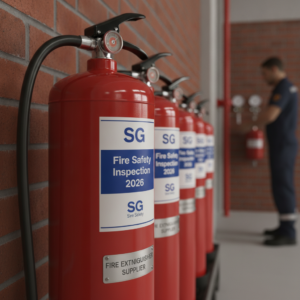
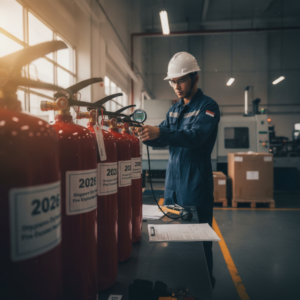
– Monthly visual checks: ensure the extinguisher is in its bracket, the pressure gauge is in the green (if fitted), seals and tamper indicators are intact, and the nozzle is unobstructed.
– Look for obvious physical damage, corrosion, leakage, or clogged discharge.
Qualified technicians perform internal inspections, functionality tests and recharge or replace components as needed.
– Some maintenance tasks and test intervals vary by extinguisher type and manufacturer; follow the manufacturer’s schedule and the guidance of licensed technicians.
For professional inspection services specific to dry powder units, review a local resource on dry powder fire extinguisher inspections.
Hydrostatic testing, recharging and when to replace
- Recharging: After any use, however minor, extinguishers must be recharged by a licensed technician before being returned to service.
- Hydrostatic testing: Certain pressurised extinguisher components require periodic pressure testing to verify cylinder integrity. Intervals depend on manufacturer recommendations and the service provider’s procedures.
- Replacement: Replace extinguishers when weight or pressure loss cannot be rectified, when hydrostatic tests fail, or when the cylinder shows irreparable corrosion or damage.
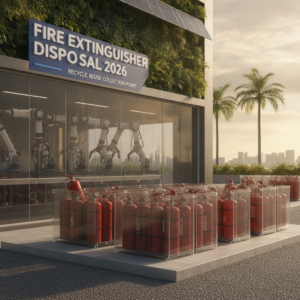
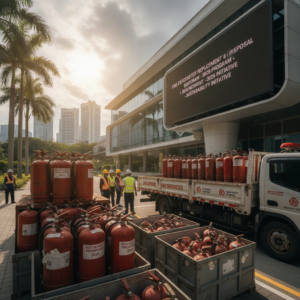
For clear procedures on safe replacement and responsible disposal in Singapore, consult guidance on fire extinguisher replacement and disposal.
Selecting a reliable Singapore supplier and service partner
A reputable local option can help with procurement, installation and scheduled servicing; see resources on top fire extinguisher supplier and servicing.
Practical tips for use and safety during a fire
- Alert and evacuate: Always raise the alarm and ensure occupants evacuate if a fire has potential to grow quickly.
- Assess before use: Use a portable fire extinguisher only on small, contained fires and if you have a clear escape route.
- PASS technique: Pull the pin, Aim at the base of the fire, Squeeze the handle, Sweep side to side.
- Maintain distance: Stand a safe distance and approach cautiously; move closer as the flame size decreases.
- After use: Report the incident, arrange professional recharge and inspect the surrounding area for reflash risks.
Remember that dry powder can obscure visibility and cause respiratory irritation — wear a mask if available and avoid enclosed spaces when possible.
Special considerations for workplaces and vehicles
- Vehicles: Keep a compact 1–2 kg dry powder extinguisher secured in commercial and private vehicles, especially if carrying flammable materials.
- Workshops and warehouses: Use larger 4.5 kg or greater units, and supplement with multiple extinguishers to meet coverage requirements.
- Kitchens: For deep-fat/frying oil fires, use dedicated wet chemical extinguishers rather than powder units.
Emerging trends in portable extinguishers and fire safety (2026)
- Digital inspection records: Many suppliers now offer mobile-enabled inspection logs and QR-code tags for quick access to service history.
- IoT-enabled cabinets: Smart cabinets with tamper alerts and status indicators are becoming more common in commercial buildings.
- Eco-conscious formulations: Suppliers are researching powders with reduced corrosivity and lower cleanup impact.
- Integrated fire response: Portable extinguishers are increasingly considered as part of a layered fire safety strategy that includes sensors, alarms and trained responders.
Adopting these trends can improve readiness and simplify compliance tracking in busy Singapore premises.
Choosing between dry powder and other extinguisher types
Dry powder is versatile, but it is not always the optimal choice. Consider the hazard:
– For offices with electronics: powder works but cleanup risk is high — CO2 may be preferable for small electrical fires.
– For kitchens: wet chemical units are recommended for cooking oil fires.
– For flammable liquids/gases and mixed-hazard sites: dry powder often provides the broadest immediate response.
A balanced fire protection plan typically includes multiple extinguisher types to match specific risks.
Final checklist for Singapore property owners (quick action items)
- Identify hazards and choose the correct extinguisher types and sizes.
- Ensure clear signage and unobstructed mounting of portable extinguishers.
- Conduct monthly visual checks and schedule annual professional servicing.
- Recharge immediately after any use; arrange professional disposal or replacement for condemned units.
- Work with reputable local suppliers and accredited technicians to maintain compliance and safety records.
To learn more about inspection programmes, supplier selection and compliant replacement routes, consult Singapore resources and experienced local service providers for tailored advice.
Portable dry powder fire extinguishers remain a highly practical tool for many Singapore settings when selected and maintained correctly — combining the right equipment with an informed maintenance plan ensures effective first response and helps meet safety obligations in 2026 and beyond.

No comment yet, add your voice below!