

Introduction
Fire safety remains a top priority across Singapore as buildings become denser and new commercial activities emerge. For many sites — from small offices to workshops and vehicle depots — the dry powder fire extinguisher is a go-to tool because of its versatility.
What is a dry powder fire extinguisher and how does it work?
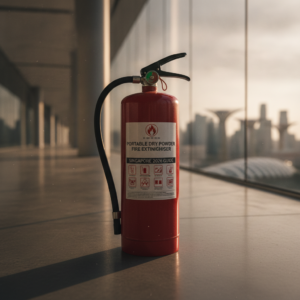
Dry powder fire extinguishers contain a fine, non-conductive powder (often monoammonium phosphate or sodium bicarbonate blends) designed to interrupt combustion chemistry. They are most commonly rated as ABC or BC types:
- ABC powder: Effective on Class A (solids like wood and paper), Class B (flammable liquids) and Class C (flammable gases) fires.
- BC powder: Effective on Class B and C fires; sometimes used where Class A performance is not required.
How it works:
- The powder forms a layer over the burning material, cutting off oxygen and chemically interfering with the fire reaction.
- Dry powder acts fast on spreading flames and is particularly useful for flammable liquid and gas fires.
Limitations:
- Powder does not cool fires well; deep-seated Class A fires can re-ignite if not fully extinguished and cooled.
- Powder dispersal creates heavy residue that can damage sensitive equipment and electronics, and requires professional clean-up.
- Not suitable for cooking oil (Class K) fires — those require wet chemical extinguishers.
fire safety landscape in 2026: what’s changed and what’s the same
By 2026, three notable trends affect how building owners approach fire safety:
- Continued enforcement of regular servicing and competency training: Routine checks and trained personnel remain key to reducing fire risk.
For practical guidance on inspection routines and documentation, consult a local resource such as this inspection checklist.
Choosing the right dry powder extinguisher for Singapore sites
Selecting an extinguisher depends on the risk profile of the premises:
- Small offices and retail: A compact ABC powder extinguisher (2–4 kg) can cover minor fires but balance size against ease of handling.
- Workshops, garages and fuel-handling areas: Larger BC or ABC units (6–9 kg) provide greater reach and capacity for liquid and gas fires.
- Industrial and high-risk areas: Combine powder extinguishers with specialized systems (foam for fuel spills, inert gas for electrical rooms) as part of a layered protection plan.
Refer to a dry powder fire extinguisher guide for model selection, ratings and local supplier options.
Placement, signage and accessibility — practical tips for compliance
Key placement principles:
- Install near escape routes and at predictable locations (near exits, stairwells, service rooms).
- Mounting height: Ensure handles are within reach for typical users; heavy units should be lower to the floor to ease lifting.
- Visibility: Use clear signage and unobstructed sightlines; avoid placing extinguishers behind doors or equipment.
- Multiple units: Large floor areas and compartments require multiple extinguishers spaced so a person can reach one within a short distance.
Maintenance, inspection and service cycles
Proper maintenance is essential to ensure a dry powder extinguisher will operate when required. Typical maintenance activities include:
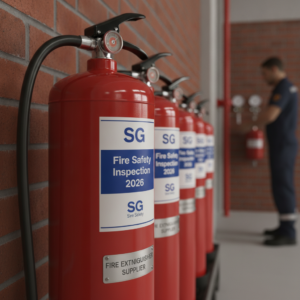
- Weekly or monthly visual checks: Pressure gauge status, pin and tamper seal intact, visible damage or corrosion.
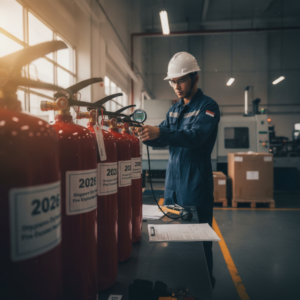
- Annual servicing by an authorised technician: Internal checks, powder condition, valve and hose inspection, recharging if needed.
- Hydrostatic testing and major overhauls: Per manufacturer instructions and industry best practice, performed at prescribed intervals to validate cylinder integrity.
For guidance on maintenance and responsible disposal of expended units see this resource on fire extinguisher maintenance.
Handling and safe operating practices for occupants
Using a dry powder extinguisher safely is as important as having one. Train occupants in the PASS method adapted for powder agents:
- Pull the pin.
- Aim the nozzle at the base of the fire (not the top of flames).
- Squeeze the handle in controlled bursts.
- Sweep the nozzle side-to-side to blanket the fire.
Safety considerations:
- Maintain a safe distance — powders can reduce visibility and irritate airways.
- Avoid confined spaces without proper respiratory protection; powder inhalation can be harmful.
- After extinguishing, ventilate the area and arrange professional clean-up to protect electronics and sensitive equipment.
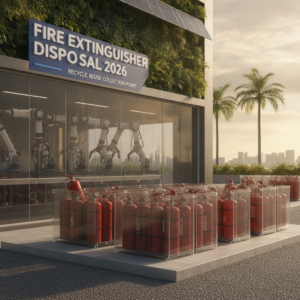
Disposal, recharging and environmental considerations
Dry powder residue and discharged cylinders must be handled responsibly:
- Recharge after any use, even partial discharge; recharging should only be performed by authorised technicians.
- Disposal of spent powder and contaminated materials must follow local waste disposal practices. Some powders are treated as non-hazardous solid waste but require containment and specialist cleaning for electronics.
- Cylinder recycling and proper decommissioning avoid safety risks; ask your service provider about environmentally responsible disposal.
For detailed end-of-life and recharge processes consult a professional guide, such as this fire extinguisher maintenance and disposal.
Emerging trends affecting dry powder use and fire safety in 2026
- IoT and sensor integration: Remote monitoring solutions can flag tamper status and pressure changes, reducing the chance of unnoticed faults.
- Cleaner alternatives: For sensitive environments, powder-free suppression for certain hazards (e.g., clean agents, pre-engineered suppression) is gaining traction, though powder remains valuable for many flammable-liquid and gas applications.
- Sustainability considerations: Service companies are offering more environmentally conscious disposal and recharging options.
To explore modern inspection and asset-management approaches, review this inspection checklist.
Practical checklist for owners and facility managers (Singapore-focused)
- Carry out a documented risk assessment of fire hazards and match extinguisher types to risks.
- Ensure visible placement and signage for each extinguisher; verify accessibility.
- Keep up with monthly visual checks and annual servicing by authorised technicians.
- Train staff and fire wardens in safe use, evacuation procedures and incident reporting.
- Consider smart tagging and remote-monitoring solutions to reduce administrative burden and increase reliability.
Conclusion
Dry powder fire extinguishers remain a reliable, versatile option for many fire risks in Singapore when used appropriately.


No comment yet, add your voice below!